

World News
China and India to Drive 44% of Global Economic Growth by 2026


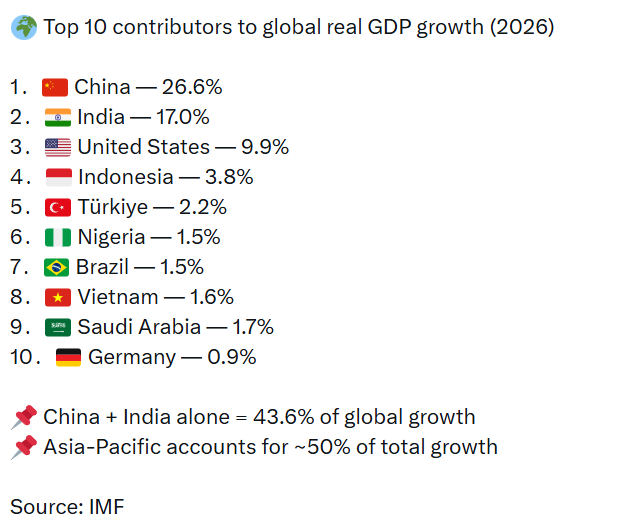
The global economic landscape is undergoing a seismic shift, with China and India projected to drive nearly half of the world’s growth by 2026. According to recent International Monetary Fund (IMF) data, the two Asian giants are expected to be the primary engines of real GDP expansion.
The figures, highlighted in a report by News 18 on Saturday, 31 January, indicate that China will lead with a 26.6% contribution to global growth, followed closely by India at 17.0%.
Together, these two nations are forecast to account for approximately 44% of the world’s economic advancement, a figure that significantly eclipses the combined contribution of most advanced economies.
Musk Weighs In
The data gained significant traction after being shared by billionaire Elon Musk on the social media platform X.
Relaying a chart originally published by World of Statistics, Musk remarked: “The balance of power is changing.”
The IMF’s January 2026 World Economic Outlook places the United States in third position with an estimated 9.9% contribution.
Other emerging economies, including Indonesia, Turkey, and Nigeria, also feature within the top ten contributors for the 2026 period.
Economic Outlook and Drivers
The IMF has slightly upgraded its global growth forecasts to 3.3% for 2026 and 3.2% for 2027, compared to its October 2025 outlook. This resilience is attributed to:
- Technological investment and private sector adaptability.
- Accommodative financial conditions and fiscal support.
- Monetary easing, which is helping to offset shifts in trade policy.
While global inflation is expected to recede, the IMF noted that the US will likely see a more gradual return to its inflation targets.
Looming Risks
Despite the optimistic growth figures, the institution warned of significant “downside risks.” A primary concern is a potential re-evaluation of Artificial Intelligence (AI) expectations.
If productivity gains from AI fail to materialise, it could trigger a sharp market correction, impacting household wealth and broader investment.
Furthermore, the IMF cautioned that escalating geopolitical tensions and trade disputes could prolong uncertainty, disrupting global supply chains and financial stability.
Source: Defi Media