
LIFE AND STYLE
Mauritian Swimming Star Becomes Harvard Scholar and New York Professor

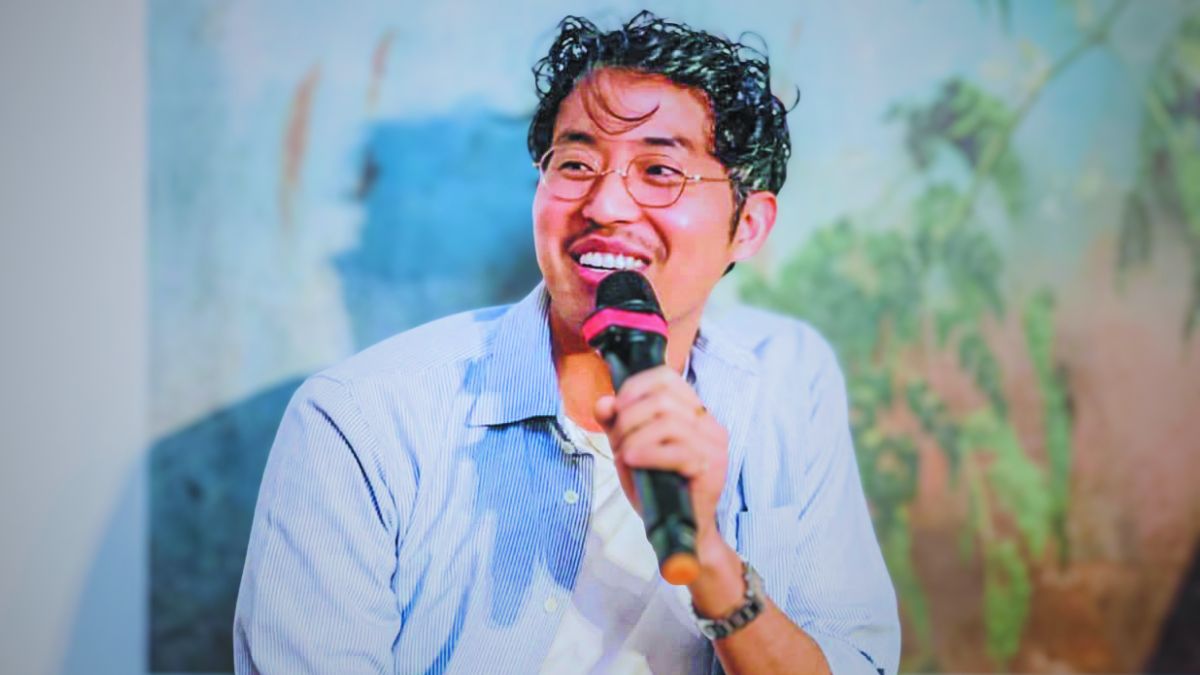
Shane Ah-Siong, the former Mauritian national swimmer who once represented the island on the world stage, has completed a remarkable transition from elite athletics to the upper echelons of American academia. At just 30 years old, the Harvard graduate has established himself as a prominent architectural researcher and professor in New York City.
The former athlete, who competed in the Junior World Championships in Dubai at age 17, now uses his platform to challenge the political nature of urban spaces.
Speaking from his base in the United States, Ah-Siong revealed how his rigorous upbringing in Mauritius—marked by up to 11 training sessions a week—forged the discipline necessary to navigate the Ivy League.
A Journey of Systems and Structures
Ah-Siong’s trajectory shifted in 2013 when he secured a prestigious United World Colleges (UWC) scholarship to Canada.
He describes this moment as a “lottery ticket” that provided a vital escape route, eventually leading to a full Shelby Davis scholarship at the University of Florida and a Master’s degree at Harvard University.
“I went from representing Mauritius—a tiny dot on the map—to realizing the brutal structural inequalities in elite sport,” Ah-Siong said.
“In Dubai, I realized you aren’t just swimming against individuals; you are swimming against systems.”
Architecture as Politics
Now a professor, Ah-Siong has moved beyond the aesthetics of design to focus on the socio-political impact of the built environment.
His work specifically examines how architecture can displace or erase communities.
- Spatial Power: He argues that every wall and urban plan is a political act.
- Colonial Legacies: He critically analyzes how “Smart Cities” in Mauritius may reproduce colonial logics.
- The Chagos Connection: His research includes the forced displacement of Chagossians to build military bases, such as Diego Garcia.
“I wanted to understand how space produces injustice, and perhaps how it could produce something else,” he explained.
The Paradox of Distance
Despite his success in New York, the professor maintains a deep connection to his roots, noting that he still carries his Creole accent as a symbolic part of his identity.
He admits to a professional paradox: his most “Mauritian” work regarding memory and spatial displacement is currently being conducted from the United States.
While he confesses to frequent bouts of “imposter syndrome” when moving between institutions like Harvard and New York’s universities, he views this doubt as a tool for critical inquiry.
“If I feel out of place, is it me, or is it the framework that was never built for someone like me?”
Ah-Siong’s transition from the “mathematical, almost military” routine of a Mauritian student-athlete to a critical voice in global architecture serves as a testament to the power of international educational pathways for the island’s youth.
Harvard’s First Full-Time Mauritian Design Student Tackles ‘Spatial Violence’ In New York Academia
Shane Ah-Siong, believed to be the first full-time student from Mauritius to attend the Harvard Graduate School of Design, is using the “institutional legitimacy” of his Ivy League background to expose how architecture is weaponised as a tool of colonial violence.
Now a professor at the New York Institute of Technology (NYIT) and the New Jersey Institute of Technology (NJIT), the 30-year-old architect and researcher argues that the discipline is “never innocent.”
From his academic base in the United States, Ah-Siong is leading critical efforts to document the disappearing spatial memories of the Chagossian community, whose archipelago was cleared to make way for the Diego Garcia military base.
The ‘Harvard Logo’ as a Key
Ah-Siong is candid about the systemic barriers facing international students, noting that while his Mauritian passport faced limitations, a document bearing the Harvard logo “opens doors” that would otherwise remain shut.
Supported by the Sinclair Kennedy Fellowship, he launched a pilot project to document the architectural history of the Chagos Islands—a history he claims is largely erased from mainstream architectural education.
“We learn the history of ‘great projects’, but never of the projects that destroyed entire communities,” Ah-Siong stated.
His work, including the Belongers exhibition in Cardiff with artist Audrey Albert, seeks to counter what he terms “spatial erasure.”
Interdisciplinary Activism
During his tenure at Harvard, Ah-Siong adopted an interdisciplinary approach, crossing into the Kennedy School of Government and Harvard Law School.
This foundation led him to view writing as a “militant act” capable of building transoceanic solidarity.
- Peer-Reviewed Research: In November 2025, he co-published a study in the Capetillo Journal alongside Kenismael Santiago-Pagán, comparing Mauritian “Smart Cities” to Act 60 in Puerto Rico.
- Art and Power: He served as a teaching fellow for world-renowned figures, including Tony Award winner Dede Ayite and Cuban political artist Tania Bruguera.
- The Corporate Path: Before teaching, his career spanned architecture firms and experiential design for global giants including Google, Samsung, and Intel.
Mauritius as a ‘Laboratory of Neocolonialism’
The professor remains a vocal critic of current urban trends in his homeland.
He describes the “Smart Cities Scheme” in Mauritius as a laboratory for “spatial neocolonialism,” arguing that these developments create enclaves for the wealthy and foreigners while pushing ordinary citizens to the periphery.
Despite his international success, Ah-Siong admits to experiencing “imposter syndrome” every semester.
He uses this feeling to remain humble and to challenge his students to consider the real-life consequences of every line they draw on a blueprint.
Advice to the Diaspora
Reflecting on his journey, Ah-Siong maintains that his path is still “under construction,” with a potential PhD on the horizon.
He issued a stark but hopeful message to young Mauritians dreaming of similar paths.
“The system is not built for us,” he warned. “You will work twice as hard for the same recognition. But being Mauritian is not a handicap; it is a unique perspective. The Mauritian diaspora must support one another.“
Source: Defi Media